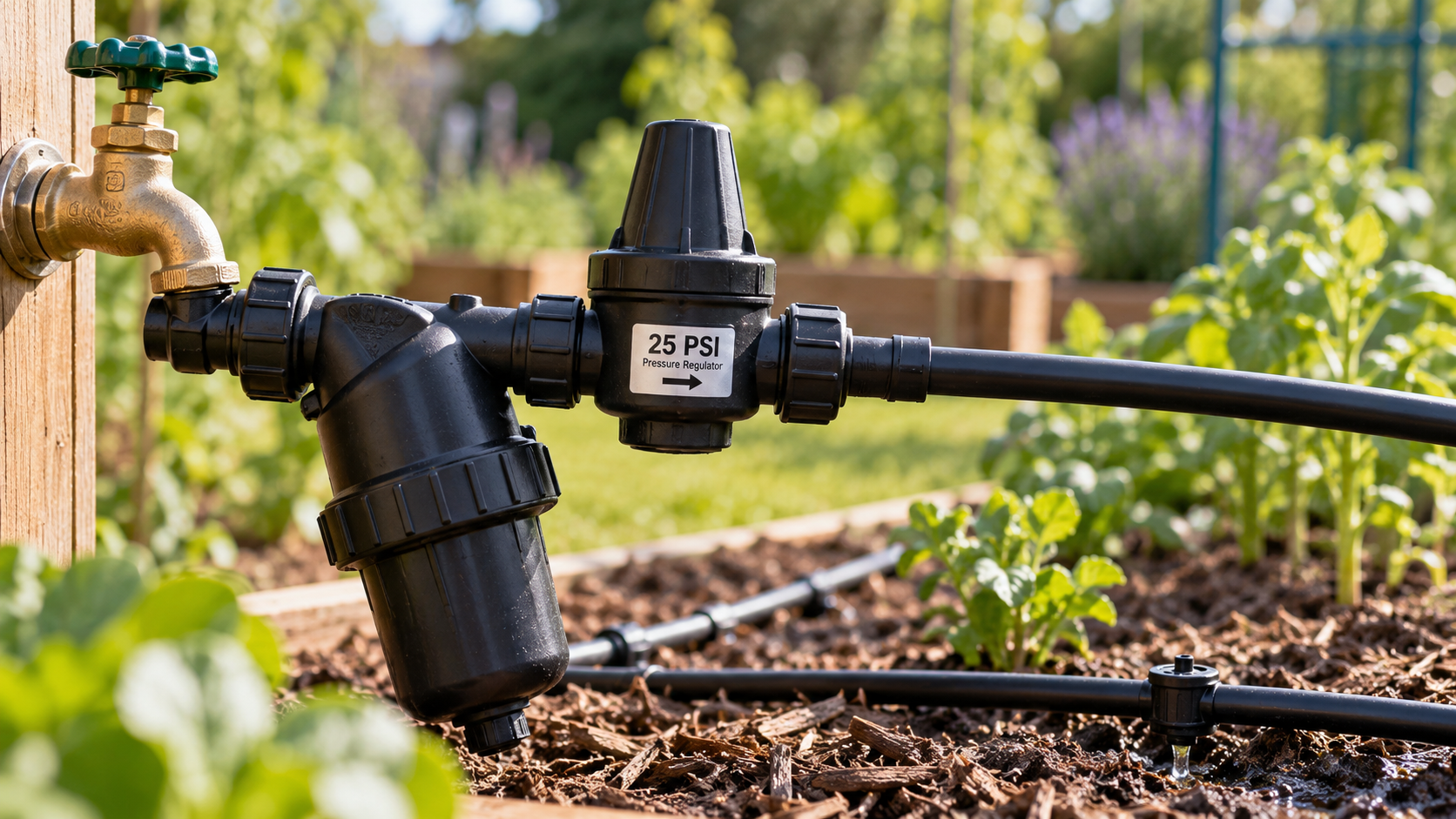
A drip irrigation system usually operates at a much lower pressure than a typical household water supply.
That is why a pressure regulator is one of the most important — and often overlooked — components of a drip irrigation setup.
If the pressure is too high, fittings can leak or disconnect, tubing can be stressed, and emitters may deliver more water than intended. But choosing a regulator with too low a pressure rating can also create problems, especially on long lines or systems with higher flow requirements.
So, do you actually need a pressure regulator for drip irrigation?
In most drip systems connected to a pressurized water source, yes. The correct pressure depends on the tubing, emitters, flow rate, and manufacturer specifications.
Here is how to choose the right one.
What Does a Drip Irrigation Pressure Regulator Do?
A pressure regulator reduces the incoming water pressure to a lower, more predictable operating pressure.
For example, your water supply might deliver considerably more pressure than your drip components are designed to handle. A regulator installed near the beginning of the system limits the downstream pressure.
This helps:
- protect tubing and fittings;
- keep emitter flow more consistent;
- reduce leaks and fittings popping apart;
- prevent excessive pressure from reaching drip components;
- improve long-term system reliability.
One important distinction is that a pressure regulator reduces pressure — it does not increase it.
If your water source already has insufficient pressure, installing a higher-rated regulator will not boost the pressure.
Do You Really Need a Pressure Regulator for Drip Irrigation?
If your drip system is connected to a normal pressurized outdoor faucet or irrigation supply, pressure regulation is generally recommended.
Drip irrigation operates differently from conventional sprinklers. Its small tubing, emitters, and fittings are designed around specific operating-pressure ranges.
You are especially likely to need regulation when:
- connecting drip tubing directly to a household faucet;
- converting an existing sprinkler zone to drip;
- using non-pressure-compensating emitters;
- using small distribution tubing;
- operating a large number of emitters from a pressurized supply.
There are exceptions.
A gravity-fed rain barrel, for example, may produce very little pressure. In that situation, the problem is often not excessive pressure but insufficient pressure. Adding a conventional regulator can make the situation worse.
Always check the operating-pressure requirements of the emitters or dripline you are using.
What PSI Should Drip Irrigation Run At?
There is no single PSI setting that is correct for every drip irrigation system.
Different products are designed for different operating pressures.
As a practical starting point:
| System type | Typical approach |
|---|---|
| Individual point-source emitters | Often around 25 PSI |
| Small distribution tubing | Often around 25 PSI |
| Non-pressure-compensating systems | Lower regulated pressure is commonly used |
| Pressure-compensating dripline | May allow higher regulated pressure |
| Gravity-fed systems | Often require specialized low-pressure components rather than a conventional regulator |
For example, Hunter recommends its 25 PSI regulation option for point-source emitters, non-pressure-compensating systems, and systems using small supply tubing.
For Hunter’s pressure-compensating HDL dripline, the company uses a 40 PSI regulation option; the emitters themselves compensate across a wider pressure range.
The important lesson is simple:
Choose the regulator based on the specifications of your drip components — not simply because a particular PSI number is popular.
25 PSI vs 30 PSI: Which Should You Choose?
Both 25 PSI and 30 PSI regulators are widely available, but the difference should not be treated as a universal “better versus worse” comparison.
A 25 PSI regulator can be a good match for many small residential point-source systems.
A 30 PSI regulator may be appropriate when the components are designed to operate at that pressure and the system needs the additional pressure.
Before choosing between them, check:
- the recommended operating pressure of your emitters or dripline;
- the required flow range of the regulator;
- the pressure available at the water source;
- the length and layout of the system.
Flow rate matters too.
A regulator only performs correctly within its specified flow range. An oversized or undersized regulator can therefore behave differently than expected even if its PSI rating appears correct.
Where Should a Drip Irrigation Pressure Regulator Be Installed?
A typical faucet-connected drip irrigation system may follow a sequence similar to:
Water source → timer/valve → backflow protection (where required) → filter → pressure regulator → main drip tubing
The exact order can vary depending on the components and manufacturer instructions.
The filter is particularly important because drip emitters contain small passages that can clog easily.
Always pay attention to the flow-direction arrow on the regulator. Installing a regulator backward can prevent it from operating correctly.
Also remember that some pressure regulators are designed to regulate pressure only while water is flowing. A pressure reading taken when the system is closed may therefore not tell you how the regulator performs during irrigation.
What Happens If Drip Irrigation Pressure Is Too High?
Excessive pressure can create several symptoms.
You may notice:
- fittings repeatedly popping off;
- leaks around connectors;
- emitters delivering excessive water;
- uneven irrigation;
- tubing swelling or becoming stressed;
- premature component failure.
If fittings keep disconnecting, do not automatically assume they are defective.
Measure the water pressure and compare it with the operating limits of the tubing and emitters.
A missing, incorrect, or failed regulator may be the real cause.
What If the Pressure Is Too Low?
Low pressure creates the opposite problem.
Typical symptoms include:
- emitters near the end of the line barely dripping;
- uneven watering;
- poor performance on long laterals;
- pressure-compensating emitters failing to operate correctly;
- some sections receiving water while others remain dry.
A pressure regulator cannot fix insufficient supply pressure.
In fact, regulators themselves require adequate upstream pressure to work correctly.
For example, Senninger specifies that many of its regulators require inlet pressure to be at least 5 PSI higher than the expected outlet pressure.
So a 25 PSI regulator generally needs sufficient upstream pressure above 25 PSI to regulate correctly.
If your system already suffers from low pressure, troubleshoot the water source, filter, valves, tubing size, system flow demand, and layout before replacing the regulator.
Why Is My Drip Irrigation Pressure So Low?
How Can You Tell If a Pressure Regulator Is Bad?
A failing regulator can sometimes look like several other irrigation problems.
Possible signs include:
- downstream pressure suddenly becoming much higher than normal;
- pressure that fluctuates significantly while the system runs;
- repeated fittings coming loose despite correct installation;
- unexpectedly low pressure after the regulator;
- irrigation performance changing even though the system layout has not changed.
Before replacing the regulator, check the filter for clogging and verify that the water source is delivering enough pressure and flow.
The best diagnostic method is to measure pressure while the irrigation system is operating.
If possible, compare:
pressure before the regulator → pressure after the regulator → regulator’s rated outlet pressure.
This can quickly reveal whether the problem is upstream, downstream, or inside the regulator itself.
Common Pressure Regulator Mistakes
1. Choosing a regulator only by PSI
PSI is important, but so is flow rate.
Check both specifications.
2. Installing a regulator to solve low pressure
A regulator cannot create pressure. It only limits pressure that is already available.
3. Ignoring emitter specifications
Do not choose the regulator first and force the rest of the system to match it.
Start with the operating requirements of your dripline or emitters.
4. Installing the regulator backward
Follow the direction-of-flow marking on the regulator.
5. Ignoring a clogged filter
A clogged filter can create symptoms that look like a pressure problem.
6. Using a standard regulator on a very low-pressure gravity system
Rain barrels and other gravity-fed systems may operate at pressures far below conventional household supplies.
Use components specifically designed for low-pressure irrigation.
Frequently Asked Questions
Can I run drip irrigation without a pressure regulator?
Sometimes, but it depends on the water source and the components.
If the supply pressure is already within the operating range specified by the manufacturer, additional regulation may not be necessary. Most residential systems connected to a pressurized water supply benefit from appropriate pressure regulation.
Does a pressure regulator increase water pressure?
No.
A regulator reduces or limits downstream pressure. It cannot increase pressure from a weak water source.
Is 40 PSI too high for drip irrigation?
Not necessarily.
Some pressure-compensating dripline products are designed to operate at higher pressures. Hunter, for example, uses a 40 PSI regulation option for its HDL pressure-compensating dripline.
For other point-source or non-pressure-compensating systems, 40 PSI may be higher than recommended.
Always follow the specifications of the actual components in your system.
Is 25 PSI enough for drip irrigation?
For many small point-source systems, it can be.
Hunter specifically recommends a 25 PSI regulation option for point-source emitters, non-pressure-compensating systems, and systems using small supply tubing.
However, 25 PSI should not automatically be used for every system.
Do gravity-fed drip systems need a pressure regulator?
Usually the bigger challenge in a gravity-fed system is obtaining enough pressure rather than reducing it.
A conventional regulator may cause additional pressure loss. Use emitters and other components designed specifically for low-pressure or gravity-fed irrigation.
Can a clogged filter cause low pressure?
Yes.
A clogged filter restricts flow and can significantly reduce pressure downstream. Check and clean the filter before assuming the pressure regulator has failed.
Bottom Line
Most drip irrigation systems connected to a pressurized water supply should use appropriate pressure regulation.
But there is no universal “best PSI.”
For many point-source residential systems, 25 PSI is a common option, while some pressure-compensating dripline systems are designed to operate at higher pressures.
The safest approach is to check the manufacturer’s operating-pressure and flow specifications for your emitters or dripline and choose a regulator that matches them.
And if your system already has low pressure, remember: a pressure regulator will not increase it.